
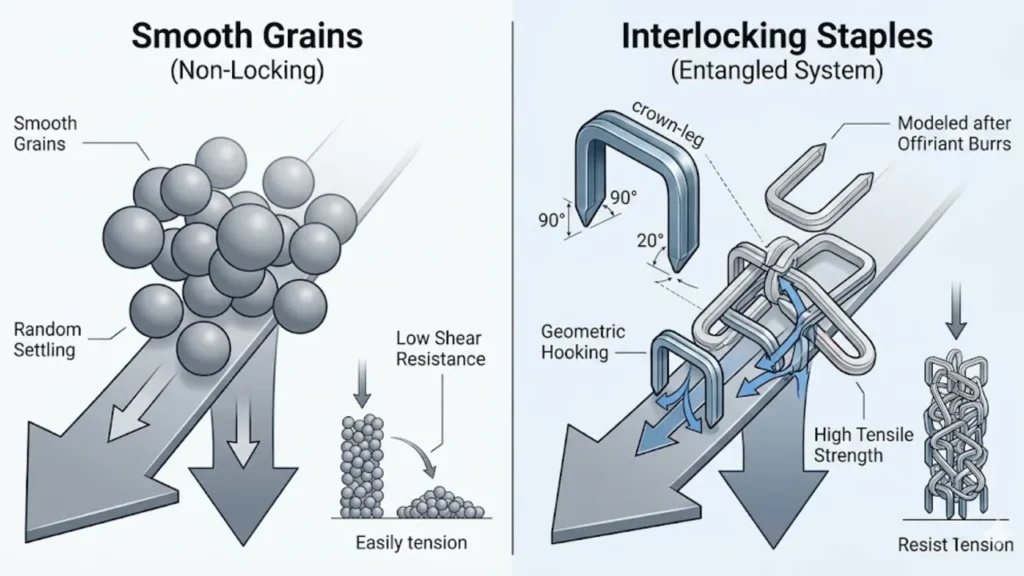

Led by Professor François Barthelat, the team discovered that by moving away from chemical adhesives and heat-based bonding, they could create a material that flows like a liquid but hardens into a load-bearing solid on command. This innovation, often compared to the legendary “liquid metal” seen in cinematic masterpieces, relies on a concept known as mechanical entanglement.
The Science of Mechanical Entanglement
To understand shape-shifting entangled materials, one must first look at the humblest of office supplies: the staple. When you have a box of loose staples, they can be poured out like water. However, once they become tangled in a pile, they form a cohesive, solid-like structure that resists being pulled apart. This is the essence of mechanical entanglement.
Beyond Chemical Bonds
Traditionally, materials derive their strength from chemical bonds—the invisible “glue” that holds atoms together. However, these bonds are permanent and energy-intensive to break and reform. Shape-shifting entangled materials bypass this limitation by using geometry. By engineering small particles into specific “hooked” shapes, the material gains its strength from physical interlocking rather than molecular adhesion.
This “geometry-first” approach allows for a rare combination of high tensile strength and extreme toughness. In the *Journal of Applied Physics*, the 2026 study highlights that these materials can absorb massive amounts of energy because the particles can slide and rearrange without “breaking” in the traditional sense.
Programming Fluidity with Vibration
The most revolutionary aspect of these shape-shifting entangled materials is their ability to transition between phases. How do you turn a rigid bridge into a flowing stream? The answer lies in controlled vibration.
The Solid State
In their default state, the particles are “locked.” Gravity and light settling cause the hooks to overlap, creating a rigid network. This solid phase can support immense weight, making it suitable for temporary infrastructure or protective armor.
The Liquid Transition
By applying specific sinusoidal vibrations—essentially shaking the material at a precise frequency—the hooks are forced to disentangle. As the particles gain kinetic energy, the material begins to “liquefy.” During this phase, it can be poured into molds, squeezed through narrow gaps, or reshaped entirely. Once the vibration stops, the material settles back into its rigid, interlocking state.
Sustainable Infrastructure and “Lego” Skyscrapers
The environmental implications of shape-shifting entangled materials are staggering. Current construction relies on concrete and treated steel—materials that are notoriously difficult to recycle. Buildings constructed with entangled particles, however, offer a path toward total circularity.
- Disassembly on Demand: Imagine a bridge that, at the end of its lifecycle, is simply “vibrated down” back into its constituent particles.
- Zero Waste: Because no chemical change occurs during the solid-liquid transition, the particles are 100% reusable without losing structural integrity.
- Seismic Resilience: In 2026, engineers are exploring “earthquake-smart” foundations that can temporarily liquefy to absorb seismic waves, preventing structural collapse before re-solidifying once the tremors pass.
Soft Robotics: The “T-1000” Reality
While we are not yet at the stage of creating sentient liquid-metal assassins, shape-shifting entangled materials are the cornerstone of the 2026 soft robotics boom. Traditional robots are limited by their rigid frames. A robot built from entangled matter can “thaw” itself to crawl through a pipe or a crack in a collapsed building during search-and-rescue missions.
Once the robot reaches its destination, it can “freeze” its particles back into a rigid state to perform heavy-duty tasks, such as lifting a concrete slab. This duality of being both the “tool” and the “fluid” is a paradigm shift for mechanical engineering.
The Road Ahead: Materials by Geometry
As we move deeper into 2026, the focus of material science is shifting from *what* a material is made of to *how* it is shaped. Professor Barthelat’s research into shape-shifting entangled materials has opened the door for “programmable matter.”
Future iterations of this technology are looking toward “biomimetic entanglement,” utilizing shapes inspired by plant burrs and bird nests to create even more aggressive interlocking networks. These advancements could lead to adjustable medical casts that perfectly conform to a patient’s limb or spacecraft components that can self-repair by “melting” and refilling cracks.
Conclusion: Shaping the World One Particle at a Time
The 2026 breakthrough at UC Boulder is more than just a scientific curiosity; it is the blueprint for a more adaptable, sustainable future. By mastering shape-shifting entangled materials, we are no longer bound by the permanence of our structures. We can build for today and reshape for tomorrow, utilizing the power of geometry to solve the most pressing challenges of the modern era.
If a simple office staple can hold the secret to the future of our cities, it reminds us that the next great innovation is often hidden in plain sight, waiting for the right frequency to unlock its potential.