
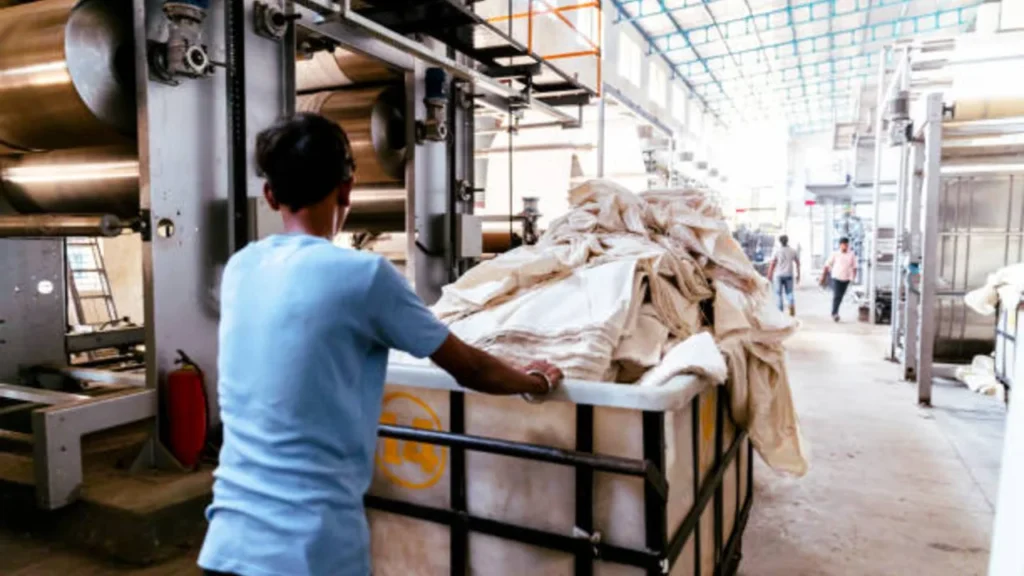

The Indonesia textile SOE Danantara strategy represents one of the most ambitious industrial revival plans in the country’s recent history. Faced with shrinking global competitiveness, rising U.S. tariffs, and regional rivals dominating apparel exports, Indonesia is betting big on a new model: a state-owned enterprise (SOE) built under the control of Danantara, its recently formed sovereign wealth fund.
With an initial investment of $6 billion, the government intends to transform the textile industry from a struggling manufacturing base into a globally competitive powerhouse. The plan is not merely to rescue failing factories—it aims to reinvent how Indonesia produces, exports, and brands its textiles in the international market.
The Context Behind Indonesia’s Textile Decline
For decades, the Indonesia textile industry has been a major employer and export earner. Its traditional strength in cotton weaving, apparel production, and cultural fabrics such as batik and ikat earned Indonesia a solid position in Asia’s manufacturing chain. But in the past ten years, the landscape has shifted dramatically.
Neighboring countries like Vietnam, Bangladesh, and India have leveraged low-cost labor and free-trade deals to capture Western buyers. Meanwhile, automation and supply-chain realignments have made competition even fiercer. By 2024, Indonesian textile exports had dropped below $12 billion—a figure that underscored a decade-long erosion of market share.
When Washington announced plans to apply 19 percent tariffs on imported Indonesian textile goods, the blow was immediate. Factories that had already been operating at thin margins faced existential threats, and workers in Central Java and West Java—two key textile hubs—saw layoffs accelerate.
Enter Danantara: The Sovereign Fund with an Industrial Mission

Danantara, short for Daya Anagata Nusantara, is Indonesia’s second sovereign wealth fund, launched in 2025 to manage long-term strategic investments. Unlike traditional investment vehicles, Danantara’s mandate extends beyond finance—it acts as a catalyst for state-owned enterprise transformation and industrial renewal.
The government’s decision to channel textile revival through Danantara signals a shift in industrial policy. Instead of piecemeal subsidies or export incentives, this new model centralizes control, capital, and coordination under a single entity that can deploy resources with long-term continuity.
What Makes Danantara Different?
- Strategic Autonomy: Operates independently from annual budget cycles, allowing multi-year planning.
- Direct Ownership: Unlike ministries, it can hold equity in projects, partner with private investors, and oversee performance.
- Technology-Driven Investment: Focused on upgrading manufacturing infrastructure with automation and sustainability in mind.
Officials argue that the Indonesia textile SOE Danantara strategy will serve as a blueprint for future industrial interventions—especially in sectors like petrochemicals and renewable materials.
The $6 Billion SOE Blueprint
The upcoming state-owned textile enterprise under Danantara is expected to consolidate multiple public and private mills, modernize equipment, and integrate operations from fiber production to finished apparel. Early reports suggest the SOE will focus on three primary objectives:
- Modernization & Automation : Deploy advanced looms, AI-based quality control, and sustainable dyeing technologies.
- Export Diversification : Reduce dependence on the U.S. market by entering Europe, Africa, and the Middle East.
- Local Value Creation : Build domestic supply chains that use Indonesian-grown cotton and synthetic fibers.
By aligning with Danantara’s funding capacity, the enterprise could avoid short-term financial pressures and focus on long-term competitiveness—something private companies have often struggled to do in Indonesia’s volatile business climate.
Opportunities for Growth
Economists see multiple potential upsides in the Danantara-led textile revival:
- Job Security : Tens of thousands of workers may regain employment through reopened or modernized factories.
- Technological Upgrading : Indonesia could finally bridge the productivity gap with Vietnam and India.
- Export Balance : Diversified markets could stabilize foreign-exchange earnings.
In addition, the new SOE is expected to support small and medium-sized enterprises (SMEs) through shared logistics, design centers, and training programs. This could create a ripple effect across related sectors like packaging, dye chemicals, and logistics.
Concerns from the Private Sector
However, not everyone supports the move. Business associations warn that introducing a large, state-backed player could distort fair competition. When an SOE has preferential access to land, financing, and political support, private textile companies risk being marginalized.
Industry analyst Siwage Dharma Negara of ISEAS-Yusof Ishak Institute notes that the challenge lies in governance: “If the SOE becomes too dominant, it could discourage private investment instead of stimulating it.” The government’s response is that Danantara will emphasize public-private partnerships and joint innovation labs to ensure inclusivity.
The Shadow of Sritex’s Collapse
The collapse of Sritex in 2025 remains a painful reminder of what happens when competitiveness and governance fail to align. Once the pride of Indonesia’s garment industry, Sritex defaulted on $1.6 billion in debt and left over 10,000 people jobless. Its downfall exposed chronic weaknesses—outdated technology, opaque accounting, and overreliance on military contracts.
Danantara’s planners cite Sritex as the cautionary example driving the creation of a professionally managed, technologically advanced textile entity with strict oversight and independent auditing.
Balancing Modern Industry with Cultural Heritage
Indonesia’s textile story is as much cultural as it is economic. Batik, songket, and ikat weaving are recognized by UNESCO and deeply rooted in community identity. While the new SOE will focus on industrial fabrics and apparel, government officials have promised to allocate funding for preserving these traditional crafts through micro-grants and export promotion programs.
This dual approach—industrial modernization alongside cultural preservation—reflects Indonesia’s attempt to define a modern yet authentic manufacturing identity in the global textile chain.
Geopolitical and Trade Implications
The Indonesia textile SOE Danantara strategy also carries geopolitical weight. As global supply chains shift away from China due to trade frictions, Western buyers are scouting “China Plus One” sourcing destinations. Indonesia aims to position itself as a reliable alternative—but doing so requires consistency, infrastructure, and trade diplomacy.
By anchoring a high-capacity, government-backed SOE in the textile sector, Jakarta hopes to send a signal to international buyers that the country can meet demand at scale, with compliance and transparency comparable to Vietnam’s export zones.
Financing and Risk Management
According to early reports, Danantara will finance the project through a mix of sovereign injections, green bonds, and foreign co-investment. The fund’s independence from Indonesia’s fiscal budget is intended to insulate it from political cycles, but this also raises accountability questions.
To mitigate risk, Danantara is expected to introduce a dual-governance model: a professional management board drawn from the private sector and an oversight committee chaired by the Ministry of State-Owned Enterprises. Regular performance audits and public reporting are designed to ensure transparency.
What It Means for the Future
If executed effectively, this strategy could restore confidence in Indonesia’s manufacturing sector and make textiles a flagship export once again. But if mismanaged, it risks reinforcing dependence on state control and eroding the private sector’s dynamism.
The outcome will hinge on three factors:
- Operational Discipline : Can Danantara maintain efficiency standards similar to global corporates?
- Partnership Ecosystem : Will SMEs and regional firms gain real benefits from integration?
- Market Adaptability : Can Indonesia keep pace with rapidly changing global fashion and materials trends?
Indonesia’s industrial evolution has often swung between state dominance and liberalization. The textile initiative under Danantara could mark a new equilibrium—one where the state acts as a strategic investor rather than a monopolistic operator.
Conclusion
The Indonesia textile SOE Danantara strategy is more than an economic experiment—it’s a statement about how emerging economies can reclaim competitiveness in a turbulent global market. By merging sovereign wealth management with industrial development, Indonesia hopes to rewrite the narrative of decline into one of sustainable, technology-driven growth.
As trade barriers tighten and global competition intensifies, Indonesia’s textile comeback will test whether centralized capital and modern governance can coexist with market innovation. The next few years will determine whether Danantara’s textile gamble becomes a model for national resilience—or a reminder that even the best strategies must adapt to global realities.