
In 2026, China’s installed solar capacity is projected to surpass coal, confirming a long-anticipated shift toward renewable dominance. For policymakers, investors, and manufacturers worldwide, understanding how China solar energy achieved this scale offers insight into the next era of global power systems.
The Rise of China’s Solar Industry

Twenty years ago, few imagined China would become the center of the solar universe. Back then, coal dominated power generation, and environmental targets were secondary to industrial expansion. Yet the tide turned quickly as smog-filled cities, rising fuel imports, and international climate pressure forced policymakers to rethink the country’s energy foundation.
In 2013, Beijing launched its first large-scale clean energy policy wave, supporting china solar projects through subsidies, feed-in tariffs, and favorable financing. The response was immediate: domestic companies began investing in polysilicon production, cell manufacturing, and module assembly. By 2020, China accounted for over 70% of the global solar manufacturing capacity, and the number has only grown since.
Why China Solar Power Leads the World
Three key factors explain how china solar power achieved dominance:
1. Industrial Scale and Vertical Integration
No other nation has built a solar ecosystem as vertically integrated as China’s. From mining raw quartz for silicon to shipping finished panels worldwide, every production stage exists domestically. This structure reduces logistics costs, ensures supply stability, and allows for rapid innovation cycles. Local giants like LONGi, Trina, and JinkoSolar have become global household names, driving down costs and scaling output.
2. Government Strategy and Long-Term Planning
The Chinese government’s “dual carbon” policy — peak emissions before 2030 and neutrality by 2060 — created a national mission around renewable energy. Instead of short-term incentives, policymakers embedded solar into industrial policy, rural electrification programs, and even international trade. Through this approach, china solar energy became both a climate solution and an export strategy.
3. Market Demand and Economic Logic
As global energy demand grew, solar’s cost advantage became irresistible. Technological progress cut module prices by more than 90% since 2010, making china solar electricity cheaper than coal in many regions. Domestic utilities and private investors seized the opportunity, building massive solar farms across resource-rich provinces like Xinjiang, Qinghai, and Inner Mongolia.
China’s Mega Solar Projects
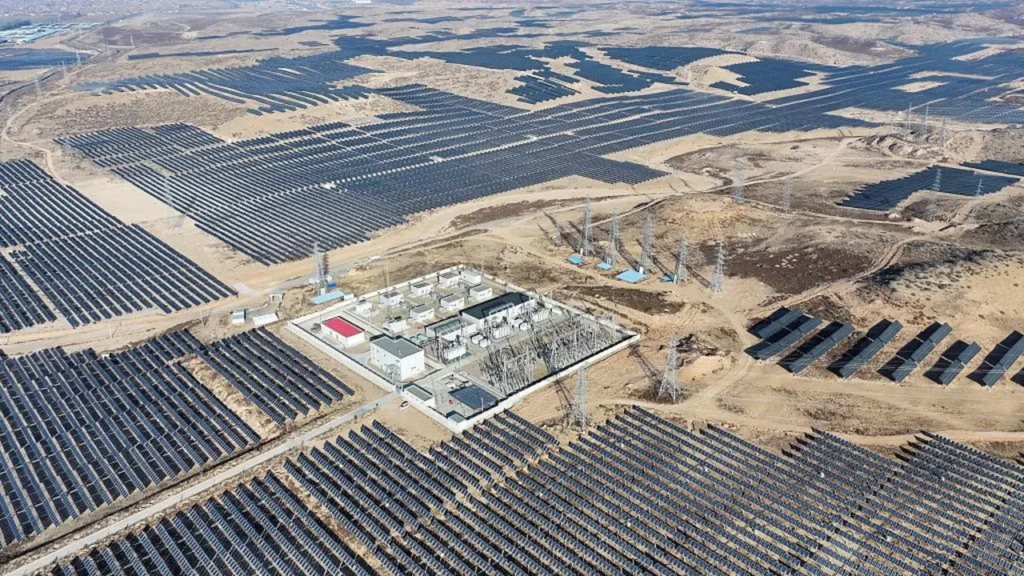
Today’s china solar market operates at an unprecedented scale. The Tengger Desert Solar Park — often called the “Great Wall of Solar” — spans over 40 square kilometers. Other sites like the Gonghe Photovoltaic Industrial Park and Qinghai’s solar-wind hybrid base showcase how renewables are becoming the backbone of regional economies.
Even rooftops are part of the transformation. Under the “Whole-County Rooftop PV” program, local governments are installing distributed solar systems on schools, factories, and residential buildings. These projects not only generate electricity but also create stable income for rural communities through feed-in tariffs and local grid participation.
China Solar Energy’s Global Reach
China’s impact goes far beyond its borders. Through the Belt and Road Initiative (BRI), Chinese firms finance and construct solar projects in Africa, Southeast Asia, and the Middle East. From Kenya’s Garissa Solar Plant to Pakistan’s Quaid-e-Azam Solar Park, Chinese engineering and capital are helping developing nations leapfrog fossil-fuel dependency.
This international expansion reinforces China’s position as the global solar hub. By exporting panels, inverters, and expertise, china solar companies are reshaping the energy infrastructure of emerging markets while securing long-term trade partnerships.
Economic Transformation Through Solar Growth
The china solar power industry has evolved from policy-driven to market-driven. It now employs millions across manufacturing, installation, logistics, and maintenance sectors. Provinces once reliant on coal mining are diversifying into green industries, fostering new regional economies around clean energy.
Moreover, solar has become a financial asset. Green bonds and renewable funds are mainstream investment vehicles, attracting both domestic and international capital. The profitability of solar projects — supported by stable policy and declining costs — ensures long-term investor confidence in the china solar energy sector.
Environmental and Climate Impacts
Every gigawatt of china solar capacity replaces significant amounts of coal-generated electricity, reducing carbon emissions and improving air quality. Urban areas once suffocated by heavy pollution now see measurable air-quality improvements. Cleaner energy reduces healthcare costs and improves quality of life, aligning public welfare with climate policy.
China’s leadership in solar also strengthens its diplomatic influence in global climate negotiations. As nations gather under frameworks like the Paris Agreement, Beijing can point to tangible progress — not just pledges — in emission reduction and clean-energy expansion.
Technology Innovations in China’s Solar Sector

The next phase of china solar technology is defined by efficiency and integration. Chinese researchers are pushing boundaries in perovskite solar cells, bifacial panels, and hybrid photovoltaic-thermal systems. These innovations increase power density and lifespan while lowering production costs.
Energy storage is another frontier. Massive investments in lithium and sodium-ion battery technology enable more stable grid integration. Coupled with smart-grid systems and artificial intelligence forecasting, these advancements help balance the intermittent nature of solar energy, making the china solar grid more resilient and responsive.
Grid Integration and Infrastructure Challenges
One of the ongoing challenges in china solar development is grid curtailment — the inability to transmit or utilize all generated electricity. In response, China has built ultra-high-voltage transmission lines that carry solar power from inland deserts to coastal cities like Shanghai and Guangzhou.
Additionally, government policies now prioritize grid access for renewable energy and require utilities to increase their green-energy quotas. These reforms ensure that the massive solar generation network contributes efficiently to national electricity demand.
China Solar Market Outlook for 2030
According to forecasts by the China Electricity Council, solar energy capacity could reach over 1,400 gigawatts by 2030 — roughly 30% of the country’s total installed power capacity. This trajectory positions china solar not just as a domestic success story but as the foundation for Asia’s clean-energy transition.
Future growth will focus on hybrid systems — combining solar, wind, and energy storage — as well as offshore floating solar farms. These technologies will extend renewable generation to new frontiers, helping stabilize power supply during peak demand and seasonal fluctuations.
Global Implications of China’s Solar Expansion
The world is watching as china solar power becomes a case study in scalable clean-energy development. For other nations, it’s proof that economic expansion and emission reduction can coexist. For global markets, it means a steady decline in renewable costs as China’s economies of scale push technology forward.
At the same time, this leadership raises strategic questions about energy dependence. As Western nations diversify their supply chains, China’s dominance in critical solar components — from wafers to inverters — remains unmatched. The balance between competition and cooperation will shape the geopolitics of the renewable era.
Conclusion: The Sun Never Sets on China’s Solar Future
From desert megaprojects to urban rooftops, china solar represents the power of scale, innovation, and state coordination. It’s more than an energy source — it’s a national strategy that fuses industrial growth, climate responsibility, and global influence.
As the rest of the world accelerates its transition to renewables, China’s solar evolution offers a living blueprint for how a developing nation can become a clean-energy superpower in just two decades. The sun that powers China’s cities today is also lighting the path for the world’s energy future.
Source: Compiled from energy industry data, Bloomberg reports, and Chinese government renewable-energy statistics.