
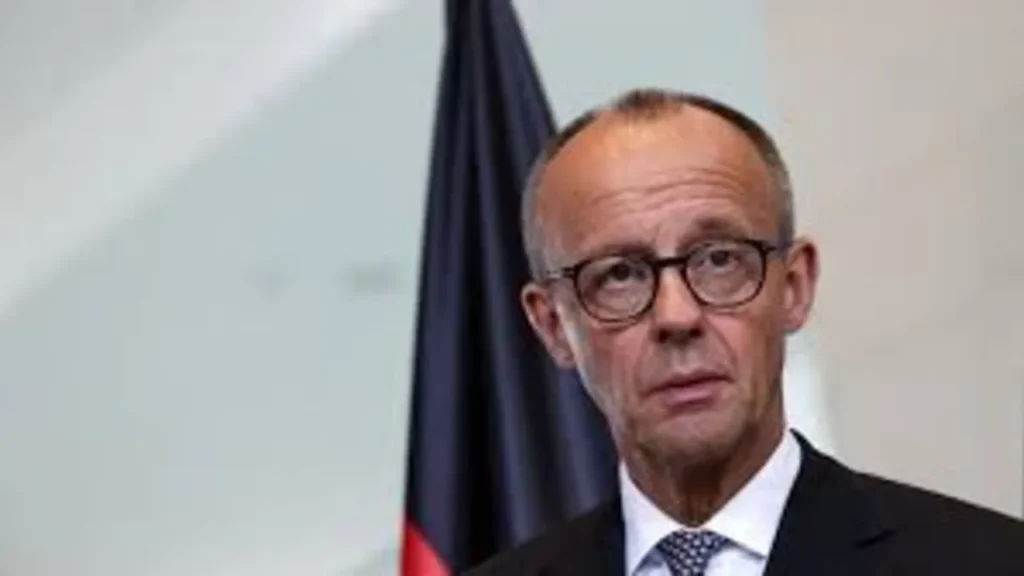

German Chancellor Friedrich Merz has renewed his firm stance on the ongoing Russia-Ukraine conflict, declaring that any truce must ensure a ceasefire that protects Ukraine’s sovereignty. In his New Year’s address to coalition partners, Merz outlined a vision for peace that prioritizes Ukraine’s independence, European unity, and lasting security in the region.
Merz’s Core Message: A Ceasefire Must Safeguard Ukraine
“We want a ceasefire that protects Ukraine’s sovereignty,” Merz wrote in his letter, stressing that peace cannot come at the expense of Ukraine’s freedom or territorial integrity. He argued that any potential deal between Kyiv and Moscow must be supported by security guarantees from the United States and Europe. Without those guarantees, he warned, any agreement would risk becoming another temporary pause rather than a sustainable peace.
His statement sets a clear tone for Germany’s foreign policy in 2026 — one that insists peace and justice must go hand in hand. According to Merz, Ukraine must emerge from this war as a secure, independent state, not as a weakened buffer zone between global powers.
Diplomatic Efforts in Paris
PTRVA – On Tuesday, Merz joined other global leaders in Paris for discussions focused on the path forward in the Ukraine conflict. The meeting included French President Emmanuel Macron, Ukrainian President Volodymyr Zelenskyy, and U.S. envoy Steve Witkoff. The goal: to explore a potential framework for a ceasefire that could open the door to long-term stability.
Merz described the talks as being held “under difficult conditions,” acknowledging the complex political realities surrounding the war. “Russia is showing only a limited willingness to negotiate, President Zelenskyy is wrestling for the unity of Ukrainians, and transatlantic cooperation has deeply changed,” he wrote. His remarks reflect the challenges faced by Western allies as they attempt to balance diplomacy with deterrence.
Security Guarantees: The Cornerstone of Peace
At the heart of Merz’s message lies a single principle — peace without security is fragile. The chancellor believes that any ceasefire must include robust security guarantees for Ukraine, possibly modeled on collective defense mechanisms within NATO or bilateral defense treaties.
These guarantees would ensure that Ukraine can defend itself from future attacks, while also assuring citizens and investors that rebuilding the nation is worth the effort. Such a framework, Merz argues, would not only strengthen Kyiv’s resilience but also stabilize Europe’s eastern flank.
“A ceasefire cannot reward aggression or leave Ukraine exposed,” Merz emphasized. “It must be backed by credible commitments — political, financial, and military — from partners who believe in a free and secure Europe.”
European Unity and Long-Term Support
Merz praised the European Union’s decision at its December summit to extend significant financial support for Ukraine’s defense and reconstruction. The agreement ensures that Kyiv will continue to receive the resources it needs to sustain its resistance and begin long-term rebuilding. “Europe has fulfilled the financial requirements to support Kyiv in its defensive war for a long time to come,” Merz noted in his letter.
This pledge sends a strong signal of unity across the continent. Despite internal disagreements and economic challenges, the EU continues to stand firm behind Ukraine, reaffirming that its future lies within a democratic and secure European community. Germany, as the EU’s largest economy, plays a pivotal role in maintaining that commitment.
Changing Transatlantic Dynamics
Merz’s remarks also reflect an evolving relationship between Europe and the United States. As Washington revisits its approach to the conflict, Merz recognizes the need for Europe to take more responsibility for its own security. “Transatlantic cooperation has deeply changed,” he observed, signaling a shift toward a more balanced partnership between both sides of the Atlantic.
While reaffirming the importance of American leadership, Merz argued that Europe must strengthen its defense capabilities and strategic autonomy. “The U.S. remains indispensable, but Europe must also be prepared to act when necessary,” he said. This sentiment highlights the growing recognition that Europe can no longer depend solely on Washington to guarantee stability in its neighborhood.
Balancing Peace, Justice, and Sovereignty
For Merz, the pursuit of peace cannot ignore the principle of justice. He emphasized that any ceasefire that protects Ukraine’s sovereignty must also ensure accountability for violations of international law. This includes maintaining sanctions against aggressors, prosecuting war crimes, and supporting the rights of displaced Ukrainians.
“Peace without justice would only invite future conflict,” Merz warned. “Our responsibility is not only to end this war but to prevent the next one.”
In Kyiv, President Zelenskyy has voiced similar sentiments, repeatedly asserting that Ukraine will not accept any settlement that compromises its independence or legitimizes occupation. This alignment of vision strengthens the credibility of Western diplomacy and underscores the shared moral foundation driving current negotiations.
Germany’s Role in Shaping Europe’s Response
Germany’s position as a leading European power gives Merz’s words particular weight. Over the past two years, Berlin has significantly expanded its defense commitments, supplying Ukraine with advanced weaponry, humanitarian aid, and training programs. At the same time, Merz’s administration continues to promote diplomatic initiatives to prevent the conflict from escalating further.
“Supporting Ukraine militarily and seeking peace diplomatically are not contradictions,” Merz explained. “They are two sides of responsible leadership.” His dual-track approach aims to combine strength with dialogue — ensuring that Europe remains both firm and forward-looking.
Public Opinion and Political Support
At home, Merz’s position resonates with many Germans who support Ukraine’s right to defend itself but also yearn for a path to peace. Recent public surveys suggest that a majority of citizens back continued assistance to Kyiv, though concerns over inflation and energy costs persist. Merz’s balanced message — emphasizing both compassion and caution — seeks to bridge those divisions.
Within the coalition, reactions remain largely positive. Members of the Green Party and Free Democrats share Merz’s view on maintaining aid and pursuing negotiations simultaneously. However, some critics argue that Germany should move faster on defense integration and play a more assertive role in shaping the European security framework.
The Paris Meeting: A Turning Point for Diplomacy
The Paris discussions represent a renewed attempt to bring momentum to peace efforts. Although no breakthrough is expected, the gathering marks a return to structured dialogue after months of military stalemate. The participation of both European and American leaders underscores the importance of a unified front.
French President Macron, known for his active diplomacy, aims to coordinate with Merz and Zelenskyy on potential frameworks for security assurances, reconstruction funding, and humanitarian cooperation. These initiatives could lay the groundwork for future negotiations — even if Russia remains reluctant to engage fully.
Beyond the Ceasefire: The Path to Reconstruction
Merz’s message goes beyond stopping the war; it envisions rebuilding a stronger Ukraine and a safer Europe. He emphasized that a ceasefire should mark “the beginning of a broader process” involving reconstruction, economic revitalization, and democratic renewal.
“Peace must be sustainable,” Merz said. “That means rebuilding homes, schools, and industries — but also restoring trust, justice, and opportunity.” He noted that Germany and the EU are prepared to lead these recovery efforts, mobilizing public and private investments to rebuild Ukraine’s infrastructure and economy.
International institutions like the World Bank and IMF have estimated that Ukraine’s reconstruction could cost hundreds of billions of euros. For Merz, this challenge represents not only an obligation but an opportunity to reinforce European solidarity and economic resilience.
Conclusion: A Vision for Just and Lasting Peace
Chancellor Friedrich Merz’s call for a ceasefire that protects Ukraine’s sovereignty encapsulates a vision of peace rooted in justice, stability, and shared responsibility. His message is not simply about ending a war — it is about shaping the future of Europe itself.
By demanding strong security guarantees, advocating sustained support for Kyiv, and promoting a unified Western response, Merz positions Germany as a key architect of Europe’s next phase. His stance reflects the growing understanding that peace cannot be imposed; it must be built upon principles that endure.
As the world watches ongoing talks in Paris and beyond, the success of this vision will depend on whether allies can transform shared ideals into lasting institutions. For Merz, the path forward is clear: only a peace that protects Ukraine’s sovereignty can protect Europe’s freedom.