
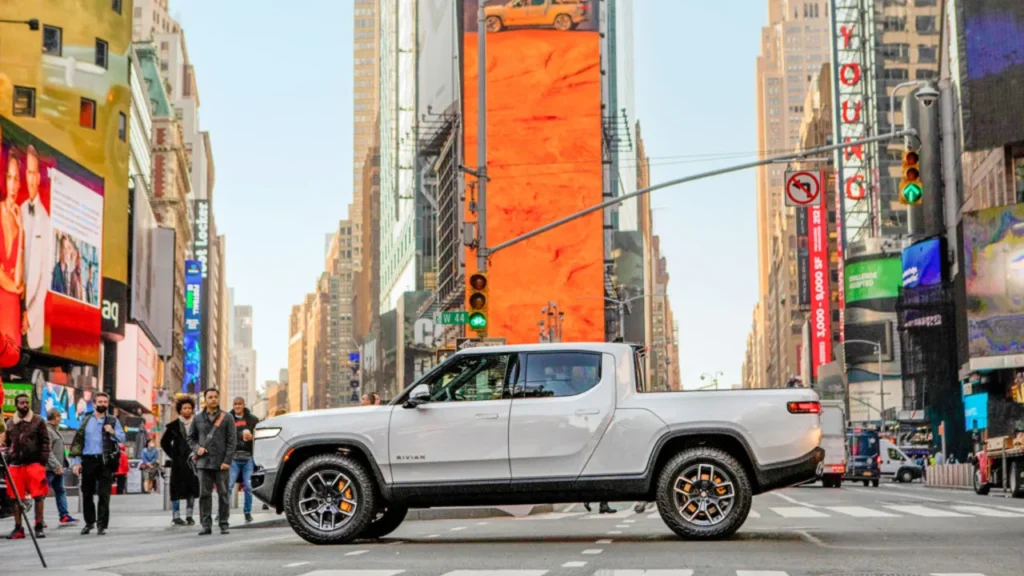

Rivian Automotive has taken a major leap into the world of artificial intelligence and self-driving innovation. During its first “Autonomy and AI Day” held on December 11, 2025, in Palo Alto, California, the electric vehicle manufacturer showcased groundbreaking developments, including custom chips, lidar-based sensing systems, and its upcoming Autonomy+ subscription service. These announcements represent Rivian’s strategic move to redefine intelligent mobility and strengthen its position in the competitive EV market.
Rivian’s AI and Autonomy Vision
At the event, RJ Scaringe, Rivian Automotive’s founder and CEO, emphasized how artificial intelligence will shape the future of mobility. He noted, “AI is enabling us to create technology and customer experiences at a rate that is completely different from what we’ve seen in the past.” Rivian’s long-term vision centers around building AI-defined vehicles — cars that continuously learn, adapt, and enhance driver convenience and safety through real-time updates and machine learning.
Rivian’s approach differs from conventional automakers by fully integrating AI not only into vehicle software but also into hardware, such as its proprietary Rivian Autonomy Processors and autonomy computers. These systems will power future generations of Rivian vehicles, enabling semi- and fully autonomous features, as well as Rivian’s forthcoming robotaxi program.
Introducing Autonomy+ Subscription Service
One of the key highlights from the event was the introduction of Autonomy+, a subscription-based service that will deliver continuously expanding self-driving capabilities. Rivian plans to roll out this offering in early 2026 for customers purchasing its second-generation vehicles. The Autonomy+ service will be priced at $2,500 upfront or $49.99 per month, making it one of the most affordable advanced driver-assistance packages on the market.
In comparison, Tesla currently charges $8,000 upfront or $99 per month for its premium Full Self-Driving (Supervised) package. Rivian’s lower pricing structure signals an effort to make advanced autonomy accessible to a wider audience, while building long-term customer loyalty through subscription-based revenue.
Hardware Innovations: Lidar and Custom Chips
To support its autonomy goals, Rivian has designed a new in-house computing architecture featuring custom chips and high-performance hardware. Vidya Rajagopalan, the company’s Vice President of Electrical Hardware, revealed that the chip uses a multi-chip module design with high memory bandwidth of 205 GB/s — critical for real-time AI applications like sensor fusion and decision-making.
Rivian’s autonomy hardware will rely on lidar (light detection and ranging) and radar sensors, unlike Tesla’s camera-only approach. This combination is expected to provide superior perception accuracy, particularly in challenging weather or low-visibility conditions. The system is being developed to achieve Level 4 autonomy as defined by the SAE Levels of Driving Automation, allowing vehicles to operate without driver input under specific conditions.
Understanding Level 4 Autonomy
A Level 4 self-driving vehicle is capable of handling most driving tasks independently, enabling the passenger to relax or even sleep while the car drives itself in normal environments. Rivian aims to reach this milestone in the near future, competing with established autonomous leaders like Waymo, Alphabet’s robotaxi division, which already operates Level 4 fleets in select U.S. cities.
Rivian Assistant: The Voice of AI
In addition to its autonomy technology, Rivian Automotiveannounced the development of Rivian Assistant, an AI-powered voice interface set to launch in early 2026. This next-generation system will allow natural conversations between drivers and their vehicles, making it easier to control navigation, entertainment, and vehicle settings hands-free.
According to Wassym Bensaid, Rivian’s Chief Software Officer, “Rivian is uniquely positioned to move from a software-defined vehicle to an AI-defined vehicle.” The Rivian Automotive Assistant will integrate directly with the autonomy platform, learning from driver habits and preferences to create a more intuitive experience.
Universal Hands-Free Driving Across North America
Rivian Automotive also announced that an upcoming software update will introduce Universal Hands-Free driving — a feature enabling hands-free navigation on more than 3.5 million miles of mapped roads across North America. This system will allow Rivian Automotive owners to enjoy stress-free driving on highways and rural roads alike, providing a massive leap forward in convenience and safety.
The company emphasized that the system will evolve over time using reinforcement learning, continuously improving its capabilities as more real-world driving data is collected from its fleet.
Robotaxi Potential and Rideshare Market Entry
During the presentation, Scaringe hinted at Rivian’s future in the robotaxi market. While the initial focus will remain on personally owned vehicles, Rivian’s advanced autonomy infrastructure opens the door to future rideshare applications. “Our initial focus will be on personally owned vehicles,” Scaringe said, “but this also enables us to pursue opportunities in the rideshare space.”
Rivian’s robotaxi ambitions position the company alongside industry pioneers like Tesla and Waymo, both of which are pursuing autonomous fleet operations. However, Rivian’s deliberate integration of lidar and radar may provide a competitive advantage in achieving consistent safety performance at scale.
Strategic Partnership with Volkswagen
Rivian’s autonomous developments exist alongside its $5.8 billion joint venture with Volkswagen. This partnership focuses on software and electrical architecture, allowing both companies to share advancements and accelerate development. However, Rivian Automotive clarified that its autonomy program remains separate from the technologies shared in the joint venture, preserving its proprietary control over the AI-driven autonomy roadmap.
Challenges in the EV Market
Despite its technological breakthroughs, Rivian Automotive continues to face pressure from investors to prove its growth potential and profitability. The U.S. electric vehicle market has slowed significantly following the suspension of the $7,500 federal tax credit earlier in 2025. Consumer demand has softened, and global competition from Chinese EV manufacturers has intensified.
While Rivian Automotive’s shares have risen approximately 25% this year, they remain down more than 80% since the company’s 2021 initial public offering. Investors are now watching closely to see whether the company’s AI-driven strategies can reignite growth and expand its customer base.
Comparing Rivian Automotive to Other Automakers
Rivian Automotive joins a growing list of automakers investing heavily in self-driving and AI technology. Tesla and General Motors are both advancing their own proprietary driverless systems. Meanwhile, Honda, Lucid, and Nissan have formed partnerships with AI-driven startups such as Helm.AI, Nuro, and Wayve to explore different approaches to autonomy.
However, Rivian Automotive’s full-stack integration — spanning from hardware chips to AI models and subscription software — sets it apart as one of the few EV makers developing a vertically integrated autonomy ecosystem.
Market Reaction and Investor Outlook
Despite the technical achievements announced at the event, Rivian’s stock fell 6.1% on the day of the presentation. Shares dropped roughly 3% during the hourlong event itself and continued to decline after OpenAI unveiled its latest AI model the same day, diverting investor attention.
Analysts suggest the decline reflects short-term skepticism rather than long-term doubt. Many see Rivian’s commitment to AI and autonomy as a transformative move that could redefine its competitive standing over the next decade.
AI: The Driving Force Behind the Future of Rivian Automotive
Rivian’s announcements represent a turning point for the company. Its transition from a software-defined vehicle to an AI-defined vehicle concept repositions Rivian Automotive as a leader in next-generation mobility. By merging machine learning, advanced sensor technologies, and scalable computing power, Rivian aims to create vehicles that not only drive themselves but continuously evolve.
As the electric vehicle industry enters a new phase of intelligent automation, Rivian’s combination of custom AI chips, lidar-equipped systems, and hands-free capabilities may prove to be the formula that finally bridges the gap between driver assistance and full autonomy.
Conclusion: A Smart Road Ahead
Rivian’s first Autonomy and AI Day underscores its determination to build a smarter, safer, and more autonomous driving experience. With the integration of Rivian Autonomy Processors, lidar sensors, and adaptive AI learning, the company is shaping a future where electric vehicles are as intelligent as they are sustainable.
While the road to Level 4 autonomy remains challenging, Rivian’s comprehensive approach — blending technology, affordability, and innovation — positions it as one of the most forward-thinking players in the EV sector. As 2026 approaches, all eyes will be on Rivian Automotive to see how its AI technology and robotaxi ambitions unfold in the fast-evolving world of autonomous mobility.