
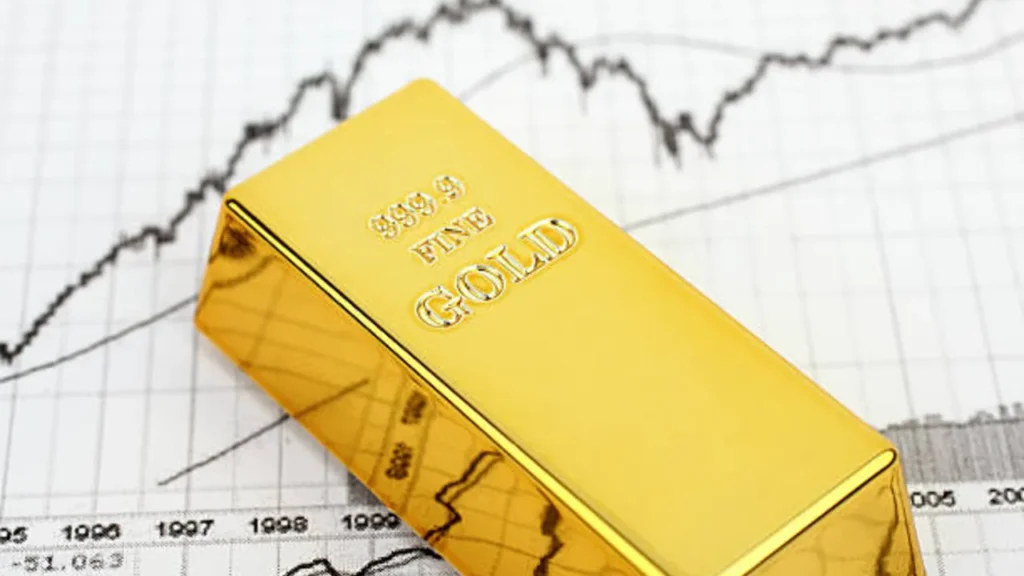

In 2025, the global financial landscape witnessed something remarkable: gold’s best year in decades. The precious metal, long viewed as a timeless store of value, reached unprecedented heights, capturing investor attention and reshaping market sentiment. Driven by economic uncertainty, shifting interest rates, and increasing demand for safe-haven assets, gold proved once again why it remains one of the most resilient investments on earth.
Why Gold Is Experiencing Its Best Year
The surge in gold prices throughout 2025 reflects a complex mix of global factors. Inflationary pressures, geopolitical tensions, and monetary policy shifts all contributed to the strong rally. As investors sought stability in an unpredictable market, gold emerged as the preferred asset to hedge against risk. By late 2025, prices had climbed more than 50% compared to the previous year — truly marking gold best year since the late 1970s.
Safe-Haven Appeal Reinforced
Whenever financial markets wobble, investors instinctively turn to gold. This year’s rally proved that instinct stronger than ever. Stock market volatility, currency depreciation, and persistent inflation reinforced gold’s reputation as a reliable hedge. Both institutional and retail investors increased their exposure, propelling gold toward record-breaking territory.
Central banks also played a major role. Many nations diversified their reserves away from traditional currencies, further amplifying demand. With every ounce purchased, global confidence in gold’s enduring value deepened, solidifying 2025 as gold best year in over four decades.
Breaking Records: How High Did Gold Go?
Throughout 2025, gold’s price trajectory was nothing short of extraordinary. Starting the year at just above $2,700 per ounce, it quickly gained momentum and surpassed $4,000 by October — the highest level ever recorded. Analysts describe the rally as historic, not only for its speed but for its resilience in the face of alternating economic signals. Despite short-term corrections, the overall uptrend remained strong.
By December, the precious metal was trading near $4,100 per ounce, a price level that made headlines worldwide. For veteran traders and newcomers alike, this performance represented a once-in-a-generation milestone — clear evidence that this was indeed gold best year in modern history.
Economic Forces Behind the Rally
Several interconnected trends created the perfect environment for gold’s surge. Understanding these drivers helps explain why 2025 became gold best year on record.
- Inflation Concerns: Rising global inflation eroded confidence in fiat currencies, prompting investors to seek refuge in assets that retain purchasing power.
- Interest Rate Cuts: As central banks lowered rates to stimulate sluggish economies, traditional interest-bearing assets became less appealing, making gold more attractive.
- Weakening Dollar: The U.S. dollar’s decline enhanced gold’s affordability for international buyers, spurring further demand.
- Geopolitical Instability: Conflicts and trade uncertainties across multiple regions added layers of risk, reinforcing gold’s safe-haven narrative.
- Central Bank Accumulation: Strategic gold purchases by emerging economies diversified their reserves and boosted global demand.
Investor Sentiment and Market Psychology
Market sentiment also played a crucial role. As uncertainty deepened, fear drove investors toward tangible assets. Social media and financial networks amplified the narrative that gold was not only a defensive asset but also a profitable one. The psychological shift from risk-taking to capital preservation was a defining feature of this cycle. The combination of fundamentals and sentiment created a feedback loop that kept demand elevated, helping sustain gold best year across all major markets.
Comparing 2025 to Previous Gold Booms
To appreciate the magnitude of 2025’s rally, it’s important to look back at historical peaks. The last time gold performed this well was in 1979, during a period marked by runaway inflation, oil crises, and global political upheaval. The parallels are striking: both eras experienced economic anxiety, shifting monetary systems, and weakening trust in paper currencies.
However, 2025 differs in one key respect — the digital economy. Unlike the 1970s, information flows instantly today, allowing investors worldwide to act in real time. This interconnectedness amplified price movements and spread the narrative of gold best year faster than ever before.
How Gold Outperformed Other Assets
Compared to stocks, bonds, and cryptocurrencies, gold’s performance stood out. While equity markets remained mixed — with some sectors thriving and others struggling — gold provided consistent growth. Bonds, typically a safe asset, underperformed due to yield compression. Even digital assets like Bitcoin showed volatility that scared off conservative investors.
For wealth preservation, gold proved unbeatable. Portfolios with even a modest 10-15% allocation to gold outperformed those without it. Financial advisors across the globe began revising their diversification models, recommending greater exposure to precious metals as part of long-term strategy — a testament to the strength of gold best year performance.
Industrial and Technological Demand for Gold
Beyond financial markets, gold’s value also stems from industrial demand. The metal plays a vital role in electronics, medical equipment, and renewable energy technologies. As the world transitions toward cleaner energy and advanced digital systems, gold’s unique properties — high conductivity and corrosion resistance — ensure ongoing consumption.
In 2025, global manufacturing demand for gold increased, particularly in semiconductor and green-tech applications. This additional layer of industrial demand contributed to tighter supply and elevated prices, reinforcing the dynamics that made this gold best year in decades.
Risks and Volatility: Not Always a One-Way Climb
Despite impressive gains, gold investors also faced periods of correction. No market moves upward indefinitely, and gold is no exception. Short-term sell-offs occurred whenever positive economic data suggested potential rate hikes or reduced inflation threats. However, these dips were often short-lived, as buyers quickly stepped in to capitalize on lower prices.
Volatility is part of gold’s nature. Successful investors recognize it as a long-term asset rather than a short-term speculative play. Those who held their positions through brief downturns ultimately benefited the most, reinforcing confidence in the enduring strength of gold best year trends.
Forecast: What’s Next for Gold Prices?
Analysts remain divided on whether the rally will continue into 2026. Some predict consolidation, arguing that gold has reached a mature phase of its bull run. Others believe the underlying fundamentals — particularly global debt, fiscal uncertainty, and monetary easing — could push prices even higher.
Most forecasts anticipate gold maintaining its elevated range, hovering between $3,800 and $4,500 per ounce in 2026. Regardless of short-term fluctuations, few doubt that 2025 will be remembered as gold best year in modern financial history, a benchmark for future market cycles.
Investor Strategies: How to Participate in the Gold Market
For those looking to benefit from gold’s continuing potential, there are several accessible investment pathways:
- Physical Gold: Buying bars, coins, or bullion for long-term holding and wealth preservation.
- Gold Exchange-Traded Funds (ETFs): Convenient financial products tracking the spot price of gold, offering liquidity without storage issues.
- Mining Stocks: Investing in companies engaged in gold extraction, which often amplify price movements.
- Gold Futures and Options: Advanced instruments for experienced traders seeking leverage and hedging opportunities.
- Digital Gold: New fintech platforms allowing investors to buy fractional gold holdings electronically.
Diversification remains key. Financial experts advise balancing gold exposure with equities, bonds, and other assets to create a stable portfolio capable of weathering multiple economic cycles. Proper allocation can ensure protection against inflation while still offering growth potential, a lesson underscored by gold best year performance in 2025.
The Role of Central Banks and Governments
Central banks were instrumental in shaping the market this year. Many emerging economies increased their gold reserves as part of a long-term de-dollarization strategy. This trend, aimed at reducing reliance on foreign currencies, strengthened global gold demand. Developed nations also maintained significant holdings, reaffirming gold’s importance in stabilizing national balance sheets.
Government fiscal policies further influenced gold’s rally. As public debt expanded and deficit spending continued, confidence in paper assets weakened. For investors, gold became not only a hedge against inflation but also a vote of skepticism toward fiat monetary systems — another defining element of gold best year narrative.
Public Perception and Cultural Symbolism
Beyond economics, gold carries deep cultural meaning. From jewelry to ceremonial objects, it represents wealth, power, and permanence. During uncertain times, these symbolic qualities regain importance. In 2025, a surge in gold jewelry demand across Asia and the Middle East mirrored rising affluence and a desire for tangible assets with intrinsic value.
This cultural dimension often overlaps with investment demand, creating a powerful feedback loop. As people witness gold’s appreciation, they are more inclined to purchase it for both financial and personal reasons. This blend of sentiment and strategy helped shape gold best year momentum across continents.
Conclusion: Lessons from Gold’s Best Year
The story of gold in 2025 is one of resilience, adaptability, and enduring relevance. Against a backdrop of economic turbulence and shifting global priorities, gold reminded the world why it remains a cornerstone of financial security. It delivered exceptional returns, outperformed rival assets, and restored faith in tangible stores of value.
For investors, policymakers, and economists alike, this period will be studied for years to come. It highlights how deeply interconnected financial systems are — and how quickly sentiment can change when uncertainty strikes. As 2025 draws to a close, one thing is certain: this has been gold best year in living memory, a milestone that redefines what stability and opportunity mean in the modern economy.