
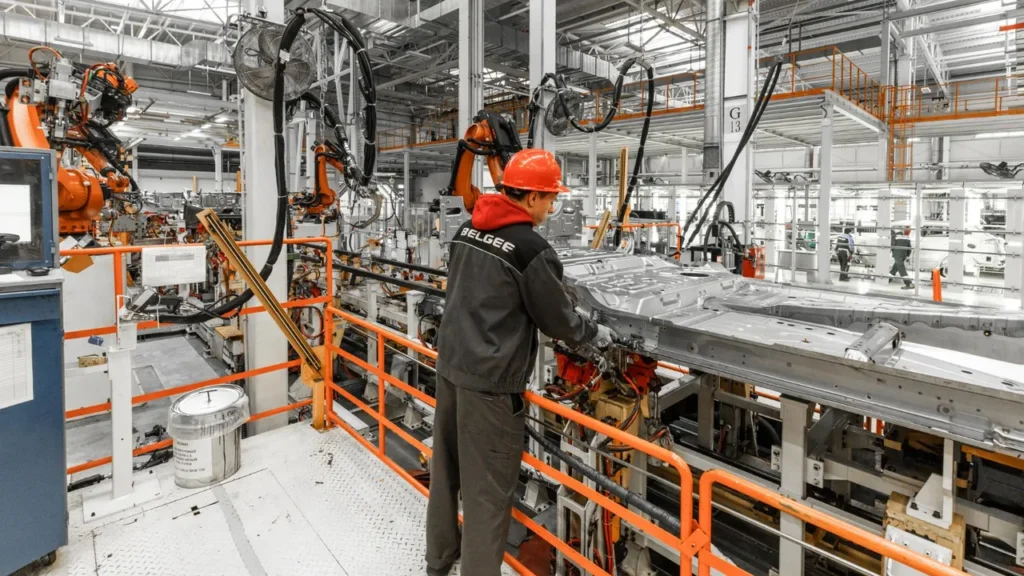

In today’s rapidly evolving industrial landscape, manufacturing companies are under constant pressure to adapt quickly, reduce costs, and improve efficiency. The traditional assembly line, once the symbol of mass production, is no longer agile enough to meet the dynamic demands of modern markets. This is where modular production systems come into play—revolutionizing how factories design, build, and scale their operations.
By integrating compact lines and plug-and-play systems, modular production enables manufacturers to reconfigure their production lines in hours instead of weeks. This level of flexibility allows businesses to optimize their output, introduce new product variants faster, and achieve operational resilience in a highly competitive global environment.
Understanding Modular Production in Modern Manufacturing
What Is Modular Production?
Modular production refers to a manufacturing approach where production lines are built using standardized, interchangeable units or modules. Each module is designed to perform a specific process—such as assembly, inspection, or packaging—and can be connected or disconnected as needed. These modules are typically automated and can communicate seamlessly through a unified digital network.
A modular setup contrasts sharply with traditional fixed lines, which require costly reconfigurations whenever a new product is introduced. In modular production, each module acts as a self-contained unit, complete with its own power supply, sensors, and control logic. This approach not only saves time but also dramatically enhances flexibility and scalability.
Evolution from Traditional to Modular Systems
Historically, manufacturing systems were designed for long production runs and minimal variation. However, with the rise of Industry 4.0, manufacturers are moving toward smaller batch sizes, frequent design changes, and customer-specific customization. These trends have made traditional assembly lines obsolete in many sectors.
The transition to modular production has been driven by advances in automation, robotics, and IoT integration. Smart factories today are able to exchange real-time data between machines, enabling predictive maintenance, adaptive scheduling, and instant reconfiguration of modules. This evolution reflects a fundamental shift from static efficiency to dynamic adaptability.
The Core Advantages of Modular Production Units
Enhanced Flexibility and Scalability
One of the main advantages of modular production is its ability to scale quickly. As demand grows, manufacturers can simply add more modules to increase capacity. Conversely, during low-demand periods, unnecessary modules can be removed or redeployed to other production lines. This flexibility makes modular systems ideal for industries that deal with fluctuating order volumes or seasonal products.
Reduced Downtime and Faster Setup
Traditional production lines often require extended shutdowns for upgrades or maintenance. With plug-and-play systems, new modules can be installed and calibrated without halting the entire line. Downtime is reduced, and production efficiency improves significantly. Furthermore, training operators becomes easier, as each module follows standardized operational protocols.
Compact Lines and Space Optimization
Another major benefit of modular production is its ability to create compact lines that maximize space utilization. In modern factories, floor space is at a premium. Modular units can be arranged vertically or in U-shaped layouts, optimizing available space while maintaining workflow efficiency. These designs are particularly advantageous for urban or high-cost manufacturing environments.
| Feature | Traditional Line | Modular Line |
|---|---|---|
| Setup Time | Weeks or months | Hours or days |
| Flexibility | Low | High (plug-and-play modules) |
| Space Efficiency | Fixed layout | Compact, reconfigurable |
| Maintenance | Requires full-line shutdown | Module-level maintenance |
Improved Quality Control and Efficiency
With modular setups, quality control processes can be integrated directly into the production flow. Each module can include automated inspection tools, such as vision systems and AI-based defect detection. This ensures real-time feedback and immediate corrective actions. Moreover, data collected from sensors across modules enables continuous optimization of process parameters.
The use of modular production also enhances overall equipment effectiveness (OEE) by minimizing idle time and optimizing machine performance. In a connected factory, data analytics identify bottlenecks, allowing engineers to reconfigure modules for optimal throughput.
How Modular Production Supports Sustainable Manufacturing
Energy and Material Efficiency
Sustainability is becoming a strategic priority in global manufacturing. Modular production units contribute to sustainability by optimizing energy consumption and reducing waste. Each module is designed for efficient operation, often powered by low-energy drives and equipped with sensors that regulate energy use based on real-time demand.
Additionally, modular systems make it easier to recycle components and materials. When a product lifecycle ends, modules can be repurposed for other production lines rather than scrapped—extending their useful life and minimizing resource waste.
Lifecycle Extension and Circular Economy
In the context of the circular economy, modular production promotes reuse and adaptability. Instead of discarding entire lines during technological upgrades, manufacturers can replace or upgrade individual modules. This extends the operational lifespan of equipment while lowering total cost of ownership.
By supporting a modular, adaptable infrastructure, manufacturers can stay competitive while aligning with environmental and social governance (ESG) goals. This combination of flexibility and sustainability represents the future of responsible industrial production.
Real-World Applications of Modular Production
Automotive and Electronics Industry
In the automotive sector, modular production has transformed assembly processes for electric vehicles (EVs). Manufacturers can easily switch between different models or battery configurations without major retooling. Similarly, in the electronics industry, modular systems streamline printed circuit board (PCB) assembly, where product variation is high and speed is critical.
By adopting compact lines and plug-and-play systems, these industries achieve faster prototyping, shorter production cycles, and reduced operational risks—positioning them at the forefront of innovation.